-


-

When the clear lines of distinction between the people of Sunnah and people of Bid’ah had been obscured by these false methodologies, much confusion and controversy was spread.
-

Islam has boundaries and outer limits which are clearly defined in the Qur’an and Prophetic traditions. A Muslim can leave Islam through certain beliefs, statements and deeds which exceed the boundaries, clash with the foundations of Islam, invalidate it, and can never be reconciled with it.
-

The four rules in this brief treatise are derived from the texts of the Qur’an and the Sunnah and from knowledge regarding the state of the Arabs in the era of the author. They comprise mighty principles and protect the one who memorises them and learns their meanings.
-

This is a small treatise from Shaykh al-Islam Muhammad bin ‘Abd al-Wahhab (may Allah have mercy on him) concerning six mighty principles of the religion of Islam.
-

The Primary Factors Contributing to The Weakness of The Ummah & The Solutions To Overcome Them
$7.00 Add to cartIn this remarkable treatise by the virtuous Salafi Imam ‘Abdul-‘Aziz Ibn Baz (may Allah’s mercy be upon him) he tackles a pressing issue that is as evident as the midday sun within the Ummah: the factors contributing to our weakness and inability to stand firm against adversaries.
-


The Souls’ Account: Commentary on the Hadiths of Al-Bara’ b. Azib and Anas b. Malik
$13.00 Add to cartThroughout history, cultures and religious traditions have asked: what happens to a person after death? Answers have ranged from reincarnation to nothingness. Yet, Allah’s Revelation has answered this question clearly.
Two of the most detailed accounts were related by the noble companions Al-Bara’ b. Azib and Anas b. Malik. In them, the Prophet ﷺ describes what happens when a person leaves this world and enters the next: the Angel of Death taking the soul, angels ascending with it to the heavens, the questioning by Munkar and Nakir, the punishment or pleasure of the grave, and more.
These narrations deal with matters of the unseen, and clarify the reward for good deeds and the recompense for evil ones. The book contains the explanations of scholars, including Al-Nawawi, Ibn Hajr, Al-Albani, Ibn Baz, Al-Uthaymin, Al-Najmi, Al-Abbad, and others.
-


A Comprehensive Guide for the New Muslim
Important lessons to help the new Muslim correctly practice Islam
Prepared by Abu Suhayl Anwar Wright HafidahullaahThis is a very beneficial book for the new Muslim, as it introduces a number of important subjects in a very simple and concise fashion.
The author is a graduate from the Islamic University of Madinah and an Islamic teacher in Philadelphia, PA, U.S.A.
This work will definitely aid the new Muslims, whether male or female, on their journey to learn more about the beautiful religion of Islam.
-
Questions & Answers Regarding the Most Important Affairs
Shaikh Abdur-Rahman As-Sa’di – Annotated by Shaikh Abdur-Razzaq Al-Badr
-
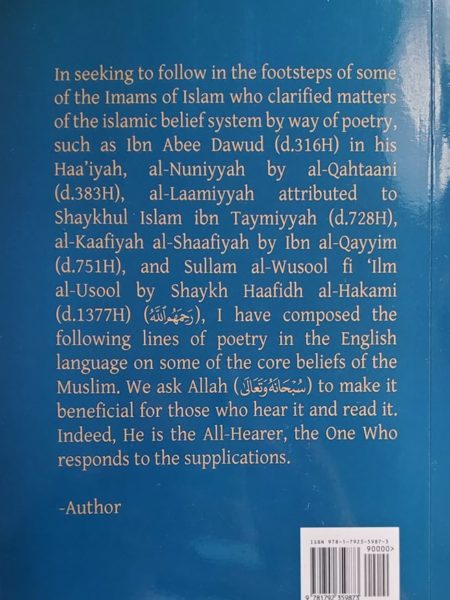
In seeking to follow in the footsteps of some of the Imams of Islam who clarified matters of the Islamic belief system by way of poetry, such as Ibn Abee Dawud (d.316H) in his Haa’iyah, al-Nuniyyah by al-Qahtaani (d.383H), al-Laamiyyah attributed to Shaykhul Islam ibn Taymiyyah (d.728H), al-Kaafiyah al-Shaafiyah by Ibn al-Qayyim (d.751H), and Sullam al-Wusool fi ‘Ilm al-Usool by Shaykh Haafidh Al-Hakami (d.1377H) (May Allah have mercy on him), I have composed the following lines of poetry in the English language on some of the core beliefs of the Muslim. We ask Allah the Most High to make it beneficial for those who hear it and read it. Indeed, He is the All-Hearer, the One Who responds to the supplications.
-


Imam Warith Deen Mohammed was the leader of a large community of Black American Muslims. During his lifetime, and after his death, he amassed a large group of supporters and loyal followers who consider him to be the reviver of Islam. He also has his share of critics.
This is an in-depth analysis of the teachings of Warith Deen Mohammed spanning 33 years and extracted from his books, writings, poems, and more than 1,500 sermons and lectures from 1975 to 2008.
-
-
-
-
-
Cart
Login
Register