-


The treatise in your hands is a short and concise, yet informative and comprehensive treatment of the affair of worship (‘ibadah).
-

Islam has boundaries and outer limits which are clearly defined in the Qur’an and Prophetic traditions. A Muslim can leave Islam through certain beliefs, statements and deeds which exceed the boundaries, clash with the foundations of Islam, invalidate it, and can never be reconciled with it.
-

The four rules in this brief treatise are derived from the texts of the Qur’an and the Sunnah and from knowledge regarding the state of the Arabs in the era of the author. They comprise mighty principles and protect the one who memorises them and learns their meanings.
-

This is a small treatise from Shaykh al-Islam Muhammad bin ‘Abd al-Wahhab (may Allah have mercy on him) concerning six mighty principles of the religion of Islam.
-

Ibn al-Qayyim said: “Get up (and hurry) in servitude to Allāh and being with Him in the Home of Peace, without any tiredness, hardship or fatigue, but by the nearest and easiest of paths. And this is (by realising) that you are in a time between two times, which (constitutes) your life, and this is the present time, which is between what has passed and what is yet to come.
-

The Primary Factors Contributing to The Weakness of The Ummah & The Solutions To Overcome Them
$7.00 Add to cartIn this remarkable treatise by the virtuous Salafi Imam ‘Abdul-‘Aziz Ibn Baz (may Allah’s mercy be upon him) he tackles a pressing issue that is as evident as the midday sun within the Ummah: the factors contributing to our weakness and inability to stand firm against adversaries.
-


The Souls’ Account: Commentary on the Hadiths of Al-Bara’ b. Azib and Anas b. Malik
$13.00 Add to cartThroughout history, cultures and religious traditions have asked: what happens to a person after death? Answers have ranged from reincarnation to nothingness. Yet, Allah’s Revelation has answered this question clearly.
Two of the most detailed accounts were related by the noble companions Al-Bara’ b. Azib and Anas b. Malik. In them, the Prophet ﷺ describes what happens when a person leaves this world and enters the next: the Angel of Death taking the soul, angels ascending with it to the heavens, the questioning by Munkar and Nakir, the punishment or pleasure of the grave, and more.
These narrations deal with matters of the unseen, and clarify the reward for good deeds and the recompense for evil ones. The book contains the explanations of scholars, including Al-Nawawi, Ibn Hajr, Al-Albani, Ibn Baz, Al-Uthaymin, Al-Najmi, Al-Abbad, and others.
-


The Danger Of Innovated Principles Upon Methodology & Creed By Shaykh Hasan al-Mardawi
$14.00 Add to cart -
-


A Comprehensive Guide for the New Muslim
Important lessons to help the new Muslim correctly practice Islam
Prepared by Abu Suhayl Anwar Wright HafidahullaahThis is a very beneficial book for the new Muslim, as it introduces a number of important subjects in a very simple and concise fashion.
The author is a graduate from the Islamic University of Madinah and an Islamic teacher in Philadelphia, PA, U.S.A.
This work will definitely aid the new Muslims, whether male or female, on their journey to learn more about the beautiful religion of Islam.
-


The story of Hajar is one of faith, resilience, and trust in Allah. Left alone in the desert with her infant son, she remained steadfast, and through her struggle, Allah provided the Zamzam Well, a source of life and mercy that flows till this day.
This treatise explores Hajar’s journey, drawing from the Quran and Sunnah, with insights from scholars Al-Hafiz Ibn Hajr, Al-Allamah Ibn Baz, Al-Allamah Ibn Al-Uthaymin, and Al-Allamah Al-Sa’di . It also touches on the history of Zamzam and the Ka‘bah’s construction, showing how Hajar’s story is deeply connected to Islam’s sacred heritage. -


Prior to 1358 AH, the area spanning southern Saudi Arabia and northern Yemen was steeped in superstitions, ignorance, acts of polytheism, and innovations. But Allah would decree that the Shaykh, the reformer, ‘Abd Allah al-Qar’awi would settle in the region and establish the call of the Prophets and Messengers: the call to tawhid. He instituted schools, built masajid, delivered sermons, taught lessons in towns and villages, and introduced thousands of men, women, and children to the methodology of the Salaf. He was, as Shaykh Rabi’ b. Hadi al-Madkhali said of him, “knowledgeable, pious, ascetic, earnest, patient, and dependent upon [Allah Alone] in his call. He was Salafi in creed, upon the ‘aqidah of Ahl al-Sunnah wa al-Jama’ah.”
-


Forty Hadith Concerning the Fast of Ramadan
Before the reader is a collection of forty authentic Prophetic traditions concerning the fast of Ramadan, with brief commentary from the noble scholars of Islam. This is in keeping with the longstanding tradition of the muhaddithun collecting forty hadiths from the Messenger of Allah on various subjects.
Concerning this tradition, Hafiz al-Nawawi wrote in the introduction to his Forty Hadith, “The religious scholars, may Allah be pleased with them, have composed countles works in this field. The first one I have known to do so was ‘Abd Allah b. al-Mubarak, followed by the rabbani scholar Muhammad b. Aslam al-Tusi, followed by Al-Hasan b. Sufiyan al-Nasa’i, Abu Bakr al-Ajurri, Abu-Bakr Mubammad b. Ibrahim al-Asfahani, al-Daraqutni, al-Hakim, Abu Nu’aym, Abu ‘Abd al-Rahman al-Sulami, Abu Sa’id al-Malini, Abu ‘Uthman al-Sabuni, ‘Abd Allah b. Muhammad al-Ansari, Abu Bakr al-Bayhaqi, and inumerable others, from the earlier and later scholars.”
This treatise covers several important topics: beginning the fast with the sighting of the new moon, making intentions to fast, eating the suhur meal, guarding one’s tongue during the fast, hastening to break the fast, etc.
-
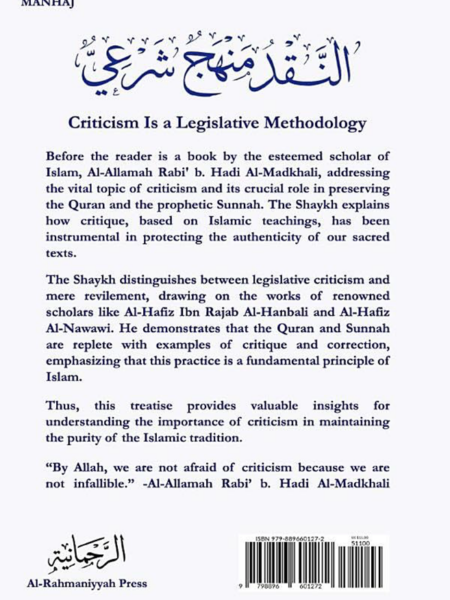
-
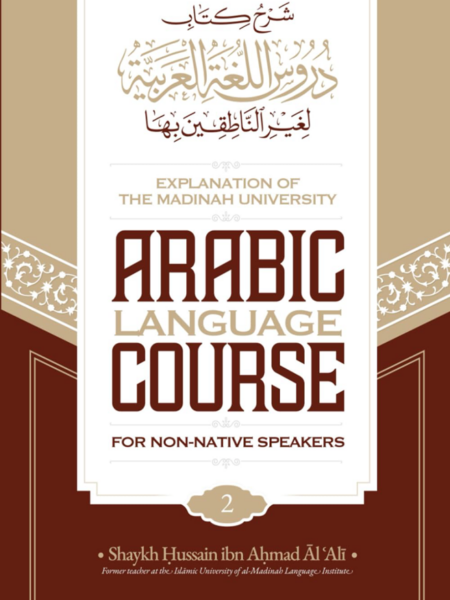
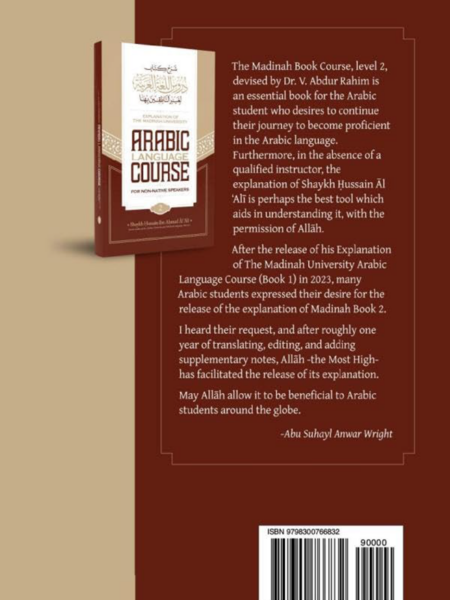
Explanation of the Madinah University Arabic Language Course for Non-Native Speakers: Book 2
$24.00 Add to cartThis is the explanation of the first book of the world renowned Madinah Arabic Course series, originally authored by Dr. V Abdur Rahim, and taught in the Islamic University of Madinah, Saudi Arabia. Highly recommended for anyone studying the Madinah Book course and desiring to grasp the principles of the Arabic language.
-
Cart
Login
Register